For a long time, women were told a version of the same story when they raised questions about their health.
The symptoms were common. Hormonal fluctuations were expected. Fatigue, pain during menstruation, shifts in mood or concentration. These were often treated as ordinary aspects of life rather than signals that required deeper interpretation. None of these experiences were particularly rare. In fact, women have described them with remarkable consistency for generations. What has been missing, more often than not, are systems designed to understand them.
For much of the twentieth century, women were routinely excluded from clinical research trials. Researchers worried that hormonal variability might complicate results, so female participants were frequently left out of studies entirely. It was not until the NIH Revitalization Act of 1993 that federally funded research in the United States was required to include women.
The consequences of that exclusion are still visible today. Much of modern medical research was built using male physiology as the baseline reference point.
Even now, the imbalance persists in quieter ways. A widely cited analysis published in Nature Communications estimates that only about five percent of global health research funding is directed toward conditions that primarily affect women. The gap is not simply financial. It shapes which questions get asked, which symptoms receive attention, and which experiences are treated as medically meaningful.
When systems are built on incomplete data, interpretation becomes difficult. That difficulty often shows up in daily life. Many women describe feeling sharp and capable one week and unexpectedly drained the next. Sleep patterns shift mid-cycle. Energy fluctuates. Focus comes and goes in ways that are difficult to explain through a single cause.
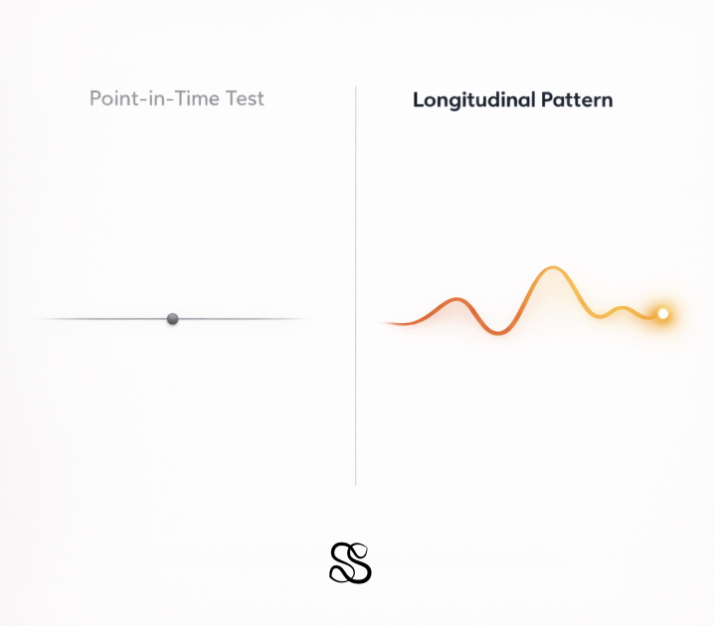
These patterns are rarely random. But they are often difficult to interpret in isolation.
In the absence of clear interpretation, people do what they have always done. They look for answers where they can find them. Some turn to physicians. Others search online. Many keep personal notes or journals, trying to observe patterns in their own experience.
Over the past decade, digital health tools have attempted to fill part of this gap. Period tracking apps, wearable devices, and wellness platforms have expanded dramatically. Millions of women now log symptoms, cycles, sleep patterns, and daily signals that would have been nearly impossible to track a generation ago.
The visibility into personal health data has improved significantly.
That difficulty often shows up in daily life. Many women describe feeling sharp and capable one week and unexpectedly drained the next. Sleep patterns shift mid-cycle. Energy fluctuates. Focus comes and goes in ways that are difficult to explain through a single cause.
These patterns are rarely random. But they are often difficult to interpret in isolation.
In the absence of a clear interpretation, people do what they have always done. They look for answers where they can find them. Some turn to physicians. Others search online. Many keep personal notes or journals, trying to observe patterns in their own experience.
Over the past decade, digital health tools have attempted to fill part of this gap. Period tracking apps, wearable devices, and wellness platforms have expanded dramatically. Millions of women now log symptoms, cycles, sleep patterns, and daily signals that would have been nearly impossible to track a generation ago.
The visibility into personal health data has improved significantly. Yet measurement alone rarely produces understanding. A predicted cycle date can help with planning, but it does not necessarily explain why concentration feels different on a particular day. A sleep score might indicate lower recovery, but it rarely connects that signal to other factors that might be influencing how someone feels.
The result is a curious paradox. Women are generating more health data about themselves than ever before, yet many still find themselves asking the same basic question.
Why do I feel the way I do today?
Part of the challenge lies in how most tools approach the body. Many focus on isolated signals or singular measurements. But human biology, particularly female biology, rarely operates through isolated moments. Hormones fluctuate across time. Energy rises and falls. Cognitive and emotional states shift in ways that are often cyclical rather than linear.
Understanding those rhythms requires observation across longer periods.
In other fields, similar challenges have led to a different type of solution. Financial markets, logistics networks, and climate systems all rely on intelligence layers designed to synthesize complex streams of information into patterns that humans can interpret.
Something similar now appears to be emerging in personal health technology.
Instead of simply logging data or predicting dates, a new generation of systems is beginning to focus on pattern recognition across time. The goal is not merely to collect signals but to translate them into context that helps individuals understand how their bodies actually function in daily life.
For women, this shift may be particularly meaningful.
Much of female physiology unfolds through rhythms that are difficult to interpret through snapshots alone. When those rhythms are observed across weeks or months, patterns often begin to emerge. Energy fluctuations that once felt unpredictable begin to make sense. Changes in sleep, focus, or mood appear less random and more connected.
Understanding, in other words, compounds over time.
The idea behind this approach is surprisingly simple. Biological data is not merely something to measure. It is information that can help people make sense of their own experience when it is observed carefully enough.
That shift in perspective is beginning to shape how some founders and researchers are thinking about the future of women’s wellness technology. Rather than building tools that only track or quantify the body, they are exploring systems that can observe patterns across time and reflect them back in ways that help individuals understand themselves.
The ambition is not to replace medical care or clinical expertise. It is to close a quieter gap that has existed for decades: the everyday space where millions of women are navigating changes in their bodies without the context to interpret them. Understanding the body should not require guesswork.
And increasingly, women are beginning to expect systems that make that understanding possible.
The Saela Sync – Newsletter March 2026 Edition explores emerging patterns in how women experience daily wellbeing and how technology may evolve to better support that experience.
The goal is simple: move from fragmented data toward systems that help women understand their bodies in context.
If any of this sounds familiar:
- You feel sharp and energized one week, then foggy and flat the next, with no clear reason why
- Your sleep shifts mid-cycle and no one has explained why that happens
- PMS arrives like a surprise every month, even though it shouldn't be
- You've tried wellness trends that seem to help some people, but you're still guessing whether they're working for you
This is what Saela Sync is designed to give you. Become a founding member: https://www.saelasync.com/signup
Sources:
🔗 NIH Office of Research on Women's Health: https://orwh.od.nih.gov/toolkit/recruitment/history
🔗 University of Leeds / European Heart Journal: https://www.leeds.ac.uk/news-health/news/article/3905/heart-attacks-in-women-more-likely-to-be-missed
🔗 UCL Professor John Guillebaud, Period Pain Study: https://www.ucl.ac.uk/news/headlines/2019/aug/period-pain-comparable-heart-attacks-some-women
#WomensHealth #Femtech #SaelaSync #AIForWomen #WomensWellness #CycleAwareness #HealthTech #Newsletter
For a long time, women were told a version of the same story when they raised questions about their health.
The symptoms were common. Hormonal fluctuations were expected. Fatigue, pain during menstruation, shifts in mood or concentration. These were often treated as ordinary aspects of life rather than signals that required deeper interpretation. None of these experiences were particularly rare. In fact, women have described them with remarkable consistency for generations. What has been missing, more often than not, are systems designed to understand them.
For much of the twentieth century, women were routinely excluded from clinical research trials. Researchers worried that hormonal variability might complicate results, so female participants were frequently left out of studies entirely. It was not until the NIH Revitalization Act of 1993 that federally funded research in the United States was required to include women.
The consequences of that exclusion are still visible today. Much of modern medical research was built using male physiology as the baseline reference point.
Even now, the imbalance persists in quieter ways. A widely cited analysis published in Nature Communications estimates that only about five percent of global health research funding is directed toward conditions that primarily affect women. The gap is not simply financial. It shapes which questions get asked, which symptoms receive attention, and which experiences are treated as medically meaningful.
When systems are built on incomplete data, interpretation becomes difficult. That difficulty often shows up in daily life. Many women describe feeling sharp and capable one week and unexpectedly drained the next. Sleep patterns shift mid-cycle. Energy fluctuates. Focus comes and goes in ways that are difficult to explain through a single cause.
These patterns are rarely random. But they are often difficult to interpret in isolation.
In the absence of clear interpretation, people do what they have always done. They look for answers where they can find them. Some turn to physicians. Others search online. Many keep personal notes or journals, trying to observe patterns in their own experience.
Over the past decade, digital health tools have attempted to fill part of this gap. Period tracking apps, wearable devices, and wellness platforms have expanded dramatically. Millions of women now log symptoms, cycles, sleep patterns, and daily signals that would have been nearly impossible to track a generation ago.
The visibility into personal health data has improved significantly.
That difficulty often shows up in daily life. Many women describe feeling sharp and capable one week and unexpectedly drained the next. Sleep patterns shift mid-cycle. Energy fluctuates. Focus comes and goes in ways that are difficult to explain through a single cause.
These patterns are rarely random. But they are often difficult to interpret in isolation.
In the absence of a clear interpretation, people do what they have always done. They look for answers where they can find them. Some turn to physicians. Others search online. Many keep personal notes or journals, trying to observe patterns in their own experience.
Over the past decade, digital health tools have attempted to fill part of this gap. Period tracking apps, wearable devices, and wellness platforms have expanded dramatically. Millions of women now log symptoms, cycles, sleep patterns, and daily signals that would have been nearly impossible to track a generation ago.
The visibility into personal health data has improved significantly. Yet measurement alone rarely produces understanding. A predicted cycle date can help with planning, but it does not necessarily explain why concentration feels different on a particular day. A sleep score might indicate lower recovery, but it rarely connects that signal to other factors that might be influencing how someone feels.
The result is a curious paradox. Women are generating more health data about themselves than ever before, yet many still find themselves asking the same basic question.
Why do I feel the way I do today?
Part of the challenge lies in how most tools approach the body. Many focus on isolated signals or singular measurements. But human biology, particularly female biology, rarely operates through isolated moments. Hormones fluctuate across time. Energy rises and falls. Cognitive and emotional states shift in ways that are often cyclical rather than linear.
Understanding those rhythms requires observation across longer periods.
In other fields, similar challenges have led to a different type of solution. Financial markets, logistics networks, and climate systems all rely on intelligence layers designed to synthesize complex streams of information into patterns that humans can interpret.
Something similar now appears to be emerging in personal health technology.
Instead of simply logging data or predicting dates, a new generation of systems is beginning to focus on pattern recognition across time. The goal is not merely to collect signals but to translate them into context that helps individuals understand how their bodies actually function in daily life.
For women, this shift may be particularly meaningful.
Much of female physiology unfolds through rhythms that are difficult to interpret through snapshots alone. When those rhythms are observed across weeks or months, patterns often begin to emerge. Energy fluctuations that once felt unpredictable begin to make sense. Changes in sleep, focus, or mood appear less random and more connected.
Understanding, in other words, compounds over time.
The idea behind this approach is surprisingly simple. Biological data is not merely something to measure. It is information that can help people make sense of their own experience when it is observed carefully enough.
That shift in perspective is beginning to shape how some founders and researchers are thinking about the future of women’s wellness technology. Rather than building tools that only track or quantify the body, they are exploring systems that can observe patterns across time and reflect them back in ways that help individuals understand themselves.
The ambition is not to replace medical care or clinical expertise. It is to close a quieter gap that has existed for decades: the everyday space where millions of women are navigating changes in their bodies without the context to interpret them. Understanding the body should not require guesswork.
And increasingly, women are beginning to expect systems that make that understanding possible.
The Saela Sync – Newsletter March 2026 Edition explores emerging patterns in how women experience daily wellbeing and how technology may evolve to better support that experience.
The goal is simple: move from fragmented data toward systems that help women understand their bodies in context.
If any of this sounds familiar:
- You feel sharp and energized one week, then foggy and flat the next, with no clear reason why
- Your sleep shifts mid-cycle and no one has explained why that happens
- PMS arrives like a surprise every month, even though it shouldn't be
- You've tried wellness trends that seem to help some people, but you're still guessing whether they're working for you
This is what Saela Sync is designed to give you. Become a founding member: https://www.saelasync.com/signup
Sources:
🔗 NIH Office of Research on Women's Health: https://orwh.od.nih.gov/toolkit/recruitment/history
🔗 University of Leeds / European Heart Journal: https://www.leeds.ac.uk/news-health/news/article/3905/heart-attacks-in-women-more-likely-to-be-missed
🔗 UCL Professor John Guillebaud, Period Pain Study: https://www.ucl.ac.uk/news/headlines/2019/aug/period-pain-comparable-heart-attacks-some-women
#WomensHealth #Femtech #SaelaSync #AIForWomen #WomensWellness #CycleAwareness #HealthTech #Newsletter